
About The Department
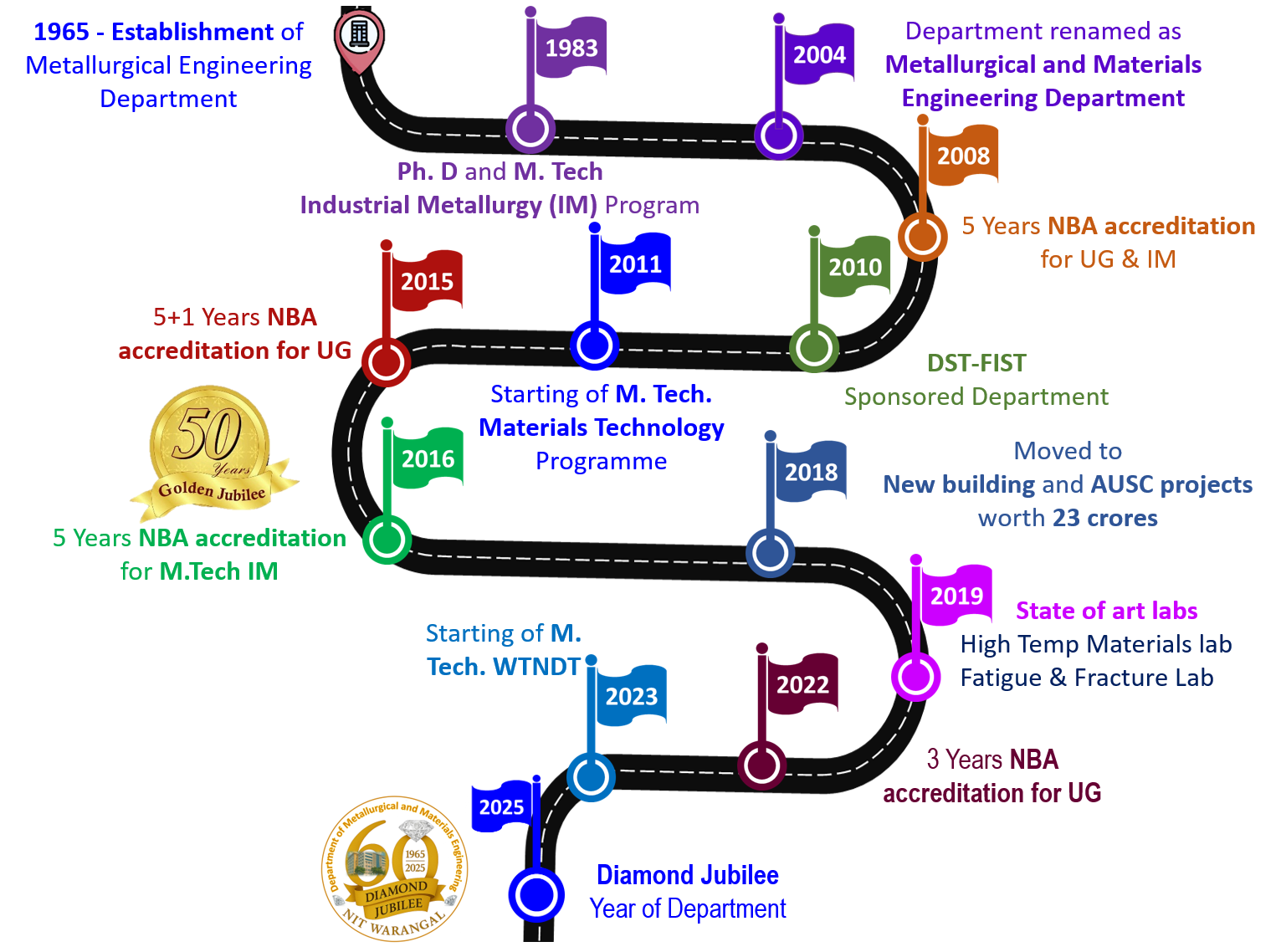
The Department of Metallurgical and Materials Engineering (formerly the Department of Metallurgical Engineering) was established in 1965 with an initial intake of 30 students. A Postgraduate program in Industrial Metallurgy and a Ph.D. program were introduced in 1983. In 2011–12, an M.Tech. program in Materials Technology was launched, followed by a new M.Tech. program in Welding Technology and Non-Destructive Testing (WTNDT) in 2023–24.
Currently, the Department offers:
- B.Tech. (4 Years) in Metallurgical and Materials Engineering
- Dual Degree (Bachelor and Master of Technology) in Metallurgical and Materials Engineering
- M.Tech. (2 Years) in Welding Technology and Non-Destructive Testing
- Ph.D. Program in Metallurgical and Materials Engineering
As per NEP 2020, the Department also offers B.Tech. (Honours) and Minor Programs in Materials Engineering.
Academic and Research Focus
The Department covers a wide spectrum of areas including:
- Extractive Metallurgy, Physical Metallurgy and Heat Treatment
- Manufacturing Technologies (Casting, Forming, Powder Metallurgy, Welding)
- Mechanical Metallurgy (Destructive and Non-Destructive Testing)
- Corrosion Engineering and Materials Characterization
To meet the growing demand for advanced materials development, the curriculum has been strengthened with subjects such as Composite Materials, Ceramics, Polymers, Energy Materials, Nanomaterials, and Computer Applications in Metallurgical and Materials Engineering.
The Department’s well-equipped laboratories feature state-of-the-art facilities supporting both teaching and research across these diverse areas.
Vision & Mission
Our Vision
Attain global recognition in research and training to meet challenging needs of Metallurgical and Materials Engineering with ethical and moral responsibility towards society.
Our Mission
-
Provide outstanding technical education for analysis, design and operation of metallurgical and materials systems.
-
Keep abreast with rapid strides of technology and improve academic standards through innovative teaching and learning processes.
-
Engage in quality research in metallurgical, materials and allied engineering areas.
-
Develop academic linkages with leading industries for mutual benefit.
-
Develop linkages with leading academic, research and industrial organizations for societal benefit.
The department is involved in cutting-edge research with funding from various government and private agencies.
18
Faculties
7
Staff
15
PhD Research Scholar
294
UG Students
10
PG Students
258
Publications